

- Tooth Preservation: A dental implant replaces a missing tooth from the root up without filing down healthy neighbouring teeth, whereas a traditional bridge requires reshaping adjacent teeth for crowns.
- Jawbone Stimulation: Implants bond directly with the jawbone (osseointegration) to help maintain bone volume, while bridges sit above the gums and do not stimulate the bone beneath the gap.
- India Cost Comparison: A traditional 3-unit bridge typically ranges from ₹15,000 to ₹45,000, while a single dental implant with crown generally ranges from ₹30,000 to ₹80,000.
- Long-Term Value: Traditional bridges typically last 5–15 years, whereas a properly placed and maintained dental implant can last several decades.
If you’ve lost a tooth, you’ve probably already asked yourself the big question: should I get a bridge or an implant? It’s one of the most common things patients want to know when they start looking at fixed, natural-looking ways to replace a tooth.
A missing tooth affects more than your smile. It can change how you chew and speak, and it can make you a little self-conscious every time you laugh. Leave the gap long enough, and the teeth around it may start drifting into the empty space while the jawbone underneath slowly shrinks.
Bridges and dental implants in Jaipur are the two most popular solutions. Both fill the gap, but they work in very different ways. They also differ in cost, in what they ask of the teeth around them and in how much care they need over the years. Let’s go through the pros and cons of each, how long they tend to last and what the cost difference really looks like, so you can make a decision you feel confident about.
1. Bridge vs Implant at a Glance
A dental bridge fills the gap with an artificial tooth that’s held in place by the natural teeth on either side. With a traditional bridge, those neighbouring teeth are fitted with crowns, and the false tooth sits between them.
A dental implant works from the root up. A small post made of titanium or another biocompatible material is placed in the jawbone to act as a new root. A custom crown is then fixed on top to form the tooth you see.
Both can look natural and let you eat comfortably again. The real differences are in the details.
| Feature | Dental Bridge | Dental Implant |
|---|---|---|
| What holds it in place | Neighbouring teeth | Jawbone |
| Surgery needed | Usually not | Yes |
| Reshaping nearby teeth | Yes, for traditional bridges | Usually not needed |
| Effect on bone | Doesn’t stimulate bone at the gap | Helps maintain surrounding bone |
| Typical lifespan | 5–15 years, sometimes longer | Implant can last decades; crown may need replacing |
| Treatment time | Often a few weeks | Often several months |
| Upfront cost | Usually lower | Usually higher |
| Cleaning | Needs cleaning under the bridge | Much like a natural tooth, with some implant-specific care |
So which one comes out ahead?
If the teeth on both sides of the gap are healthy, an implant has one big advantage: it replaces the missing tooth without touching them. Nothing gets filed down.
That said, a bridge can make a lot of sense if those neighbouring teeth already need crowns, or if implant surgery isn’t a good fit for you.
2. Why a Bridge Means Reshaping Healthy Teeth
The biggest drawback of a traditional bridge is that it borrows its support from the teeth next door.
Say you’re missing one tooth. To fit a bridge, your dentist will usually need to reshape the teeth on both sides so they can take crowns. Those crowns then hold the replacement tooth in the middle. It means removing some natural tooth structure, even if those teeth are perfectly healthy.
Here’s why that matters:
- It can’t be undone. Enamel that’s been trimmed away for a crown doesn’t grow back.
- Two teeth carry the whole load. If either supporting tooth develops decay or gets damaged, the entire bridge is affected.
- Cleaning takes more effort. You’ll need to clean carefully under the false tooth, where food and plaque like to collect.
- More treatment may follow. If problems develop, the supporting teeth may need further work later on, such as root canal treatment.
Implants avoid most of these issues because the jawbone, not the neighbouring teeth, holds them in place.
One exception worth knowing: not every bridge needs much drilling. A Maryland (resin-bonded) bridge, often used for a missing front tooth, is attached to the back of the neighbouring teeth with small bonded wings. It usually needs far less enamel removed.
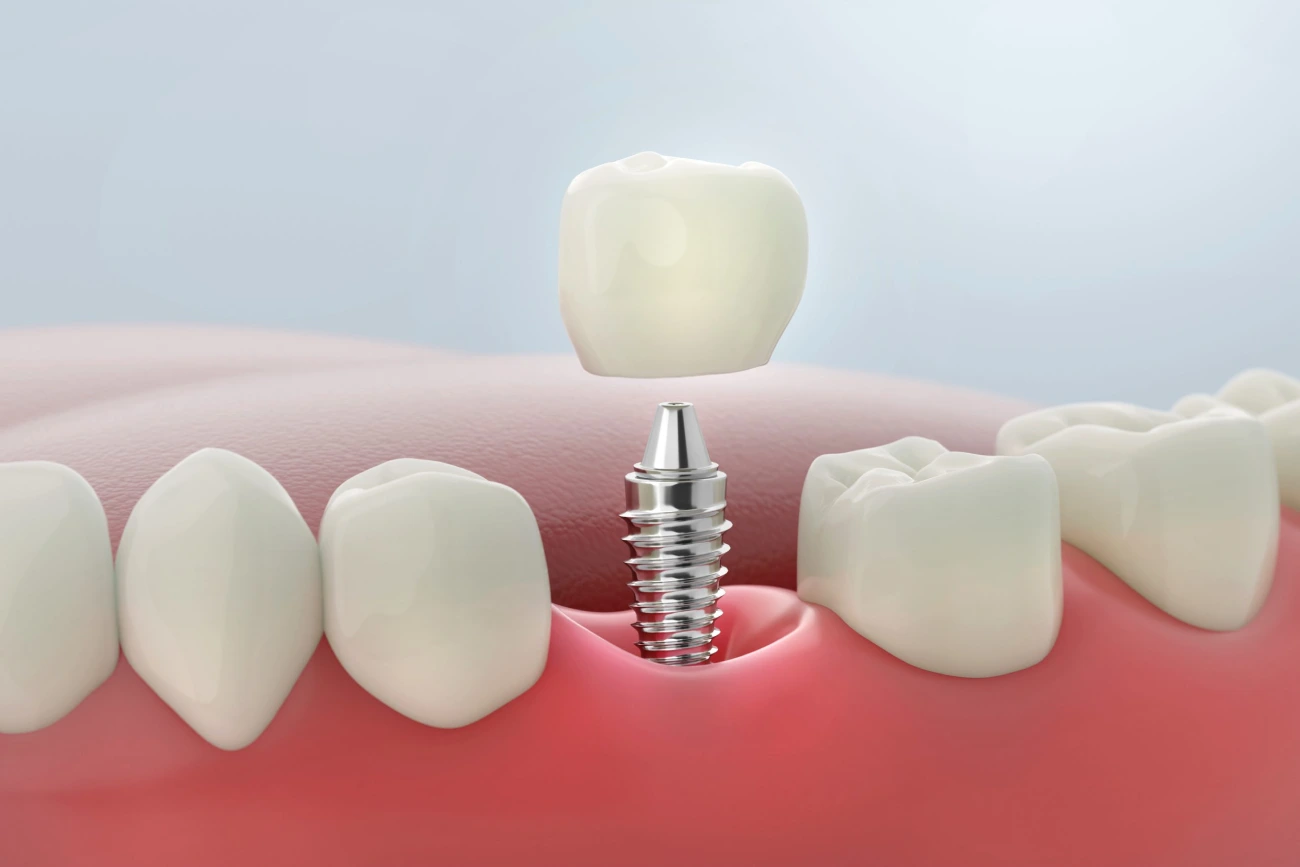 Root-Up Tooth Replacement
A dental implant replaces a missing tooth independently from the root up, leaving healthy neighbouring teeth completely untouched and unfiled.
Bridge or Implant for a Front Tooth?
With front teeth, appearance matters just as much as function. Patients exploring cosmetic dentistry in Jaipur want a replacement that blends invisibly with their natural smile.
An implant can give you a natural-looking tooth that stands on its own, without reshaping the healthy teeth beside it. But implants at the front of the mouth need careful planning. The shape of your gums, the amount of bone available, the exact position of the implant and the shade of the crown all affect how it looks in the end.
A Maryland bridge can be a good choice when you’d prefer something less invasive, particularly for some younger patients, or when an implant has to wait.
In the end, the right choice depends on your gum health, bone structure, bite, age and what you’re hoping your smile will look like.
3. Protecting Your Jawbone: How Implants Help
Your teeth do more than chew. Every time you bite, the roots send a little stimulation into the jawbone, and that helps keep the bone healthy. Once a tooth is gone, that stimulation stops, and the bone in that spot can gradually shrink. Dentists call this jawbone resorption.
What happens with a bridge?
A traditional bridge replaces the part of the tooth you can see, but not the root. So the bone beneath the gap may keep changing over time.
And with an implant?
An implant sits inside the jawbone, and over time the bone bonds to its surface through a natural process called osseointegration. Once that happens, the implant gives the area real functional support and can help maintain the surrounding bone. In practice, that can mean less bone loss where the tooth used to be, a stable base for the new tooth and a restoration that doesn’t depend on its neighbours. Learn more about the biological factors for the success of dental implants.
Can missing teeth make your face sag?
Losing several teeth, along with the bone loss that comes with it, can change the support of your face and how it looks over the years—cases where comprehensive full mouth rehabilitation is often recommended. Losing a single tooth, though, won’t necessarily cause any sagging you’d notice.
4. Dental Bridge vs Implant Cost Difference and 10-Year Longevity
Cost matters, of course. It just shouldn’t be the only thing you weigh up.
How much does a dental bridge cost in India?
As a rough guide, a traditional three-unit bridge to replace one missing tooth costs somewhere around ₹15,000 to ₹45,000. Where you land in that range depends on the material, the number of units, the clinic and the condition of the supporting teeth.
How much does a dental implant cost in India?
A single implant with its crown typically costs around ₹30,000 to ₹80,000. Complex cases or premium implant systems can cost more, and you may need to budget for extras such as a 3D scan or bone grafting. For a full component-by-component breakdown, read our detailed guide on what a dental implant really costs in India.
Please note: these are general Indian market estimates, not quotes from Dr. Chirag Chamria’s clinic.
How long does each one last?
Traditional bridges usually last around 5 to 15 years, and a well-maintained bridge can go even longer.
Implants can keep working for decades. Research has reported high 10-year survival rates, but success depends on your oral hygiene, gum health, treatment planning and other factors specific to you. And even if the implant itself stays solid, the crown on top may eventually need repairing or replacing.
What might you spend over 10 years?
Here’s a simple, hypothetical example.
Patient A pays ₹25,000 for a bridge. If it needs replacing within 10 years at the same price, they’ve spent ₹50,000 in total, not counting any other treatment.
Patient B pays ₹55,000 for a completed implant. If it stays healthy for those 10 years, that’s roughly what they’ve spent, apart from routine check-ups and cleaning.
Neither scenario is guaranteed. Plenty of bridges last well beyond 10 years, and implants sometimes need extra treatment. The real takeaway is to think about what you’re likely to need over a lifetime, not just what you’ll pay on day one.
5. The Clinical Verdict: When an Implant Makes Sense
So, which is better: a bridge or an implant?
For many adults missing a single tooth, with healthy teeth on either side, an implant is often the better long-term option. That’s provided there’s enough bone, the surrounding tissue is healthy and there’s no major medical reason to avoid surgery.
- ✓ You want to keep your healthy neighbouring teeth untouched
- ✓ You have enough jawbone, or you’re a good candidate for bone augmentation
- ✓ You’d like a replacement tooth that stands on its own
- ✓ You’re comfortable having a surgical procedure
- ✓ Long-term function and easy upkeep are high on your list
- ✓ The neighbouring teeth already need crowns
- ✓ You’d rather avoid implant surgery
- ✓ Your health or anatomy makes an implant unsuitable
- ✓ You’d like a fixed replacement in less time
- ✓ Your budget right now is limited
Whichever way you’re leaning, the right answer only comes after a proper clinical examination and the right imaging.
Dr. Chirag Chamria’s Clinical Tip
Chief Implantologist & Dental Surgeon • Royal Dental Clinic & Hospital“When a missing tooth is surrounded by healthy teeth, protecting those teeth should weigh heavily in your decision. A traditional bridge generally means preparing the teeth beside the gap, while an implant replaces the missing tooth on its own and can help preserve the jawbone around it. An implant can be an excellent long-term solution, but it isn’t automatically the right choice for every patient.”
Frequently Asked Questions
Both can look excellent. An implant avoids reshaping the healthy teeth next to it, while a Maryland bridge offers a less invasive alternative. The best choice depends on your bone and gum health, your bite, your age and how you want your smile to look.
For the right patient, it can be. An implant avoids preparing healthy neighbouring teeth and helps maintain the jawbone in that area, which can add real long-term value. Keep in mind, though, that it does involve surgical risks and needs ongoing care.
The implant itself can last several decades, though it isn’t guaranteed to last forever. The crown on top may need replacing sooner.
When needed, the teeth are prepared under local anaesthesia, so you shouldn’t feel much during the procedure. Some temporary sensitivity or soreness afterwards is normal.
A conventional bridge doesn’t replace the missing root, so it can’t directly prevent bone loss at that spot. It does, however, restore your ability to chew and helps keep your other teeth from shifting.
Conclusion
Choosing between a dental bridge and an implant isn’t about picking the cheapest option or the one that looks best on the first day.
It’s about protecting the teeth you still have, keeping your mouth working well, thinking ahead to long-term care and choosing the restoration that genuinely suits your oral health.
Implants often have clear advantages for replacing a single missing tooth, but bridges are still a reliable, proven option for the right patients.
If you’re weighing up your options, book a consultation with Dr. Chirag Chamria for a personal assessment. You’ll get a clear picture of which tooth replacement fits your dental condition, your goals and your budget.
After all, your smile deserves a plan built around you, not a one-size-fits-all answer.

Dr. Chirag Chamria (MDS)
Dr. Chirag Chamria holds a Master of Dental Surgery (MDS) in Oral & Maxillofacial Surgery & Implantology. With over a decade of surgical expertise, he specializes in Zygomatic Dental Implants, Immediate Full Mouth Rehabilitation, and Maxillofacial Oral Cancer Reconstruction at Royal Dental Clinic & Hospital, Shastri Nagar, Jaipur.
Book Your Tooth Replacement Consultation in Jaipur
Whether you are considering a dental bridge or a single dental implant, a personal clinical assessment and 3D bone evaluation with Dr. Chirag Chamria at Royal Dental Clinic & Hospital will give you a clear, customized treatment plan.
Royal Dental Clinic & Hospital Jaipur
Center for Advanced Dental Implants, Full Mouth Rehabilitation & Smile Architecture
Plot No. 7, Subhash Nagar Road, Infront of Krishna Kripa Apartment, Shastri Nagar, Jaipur, Rajasthan 302016, India
+91 96944 46633
Dr. Chirag Chamria (Oral & Maxillofacial Dental Surgeon)