

- Root canal treatment removes infected pulp tissue, cleans internal canal anatomy, and seals the tooth to save your natural tooth.
- Single-sitting root canal treatment is highly practical and comfortable for many suitable teeth using advanced rotary files and apex locators.
- Root canal costs in Jaipur range from ₹2,000 for front teeth to ₹9,000+ for multi-canal molars; always ask what is included in your consultation quote.
If you’ve ended up here, there’s a good chance a tooth is giving you trouble. Maybe it throbs at night. Maybe your morning chai suddenly hurts, or you’ve started chewing on one side without really thinking about it. Or perhaps your dentist has already said the words “root canal” and you’d like to know what you’re in for before you agree to anything.
That’s fair. Root canals have a bad reputation, and a lot of it is left over from how dentistry used to be decades ago. Things have changed. Better anaesthesia, motor-driven instruments and digital X-rays have made the treatment much more comfortable and a lot more predictable.
We’ve written this guide at Royal Dental Clinic & Hospital, Jaipur, to answer the questions patients ask us most often: what a root canal actually is, what happens during treatment, how long it takes, whether it hurts, and roughly what it costs in Jaipur.
So, What Is a Root Canal?
Your tooth isn’t solid all the way through. Under the hard outer enamel and the layer of dentine there’s a soft, living core called the dental pulp. It contains nerves, blood vessels and connective tissue, and it runs down into the roots through thin channels. Those channels are what dentists mean by “root canals.”
Most of the time the pulp is well protected. But deep decay, a crack, a fall or knock, or a tooth that has been drilled and filled many times can all give bacteria a way in. Once the pulp becomes badly inflamed or infected, it can’t repair itself. That’s usually when the pain starts, though not always.
Root canal treatment (RCT), or endodontic treatment if you want the technical name, removes that damaged pulp. The dentist then cleans and disinfects the canals and seals them up so bacteria can’t easily get back in. The outside of the tooth stays in place, and you keep using it like any other natural tooth.
Why Not Just Take the Tooth Out?
Sometimes extraction is the right call, and we’ll come back to that. But when a tooth can be saved, saving it is usually the far better option. Treating the pulp gets rid of the source of the pain. You keep chewing with your own tooth, it looks natural, and you avoid the extra time and cost of a dental implant or bridge to fill the gap later.
Signs Your Tooth Might Need Attention
Not every toothache means a root canal, so please don’t panic over a bit of sensitivity. That said, a few warning signs are worth taking seriously:
- Persistent throbbing pain: A toothache that just won’t go away, especially a throbbing one that keeps you awake at night. That kind of pain often comes from an inflamed or infected pulp.
- Lingering temperature sensitivity: A quick zing from kulfi that’s gone in a second is common and usually harmless. Pain that lingers for a while after something hot or cold is a different story and should be evaluated.
- Biting tenderness & gum swelling: Pain when you bite down can come from inflammation near the root, a cracked tooth, or localized infection. Swollen, tender gums around one tooth, or a small pimple-like bump on the gum, can mean an infection underneath.
- Tooth discoloration: A tooth that slowly turns darker after an injury may have damaged or non-vital pulp inside.
- Deep decay: If a cavity or crack has penetrated deep enough into the pulp chamber, a simple dental filling won’t protect it anymore.
One thing that surprises people: an infected tooth doesn’t always hurt. Some cause almost no pain at all until a routine digital X-ray identifies bone loss around the root apex. The only way to know for sure is an in-person clinical examination.
Urgent Note: Please don’t wait if you have facial swelling that’s spreading, a high fever, or trouble swallowing. Get urgent dental or medical care immediately.
What Actually Happens During the Treatment
Knowing the steps tends to take a lot of the fear out of it. Here is what a typical modern root canal looks like from start to finish:
Your dentist examines the tooth, asks about your symptoms and takes digital X-rays. These show the precise shape of the roots, the health of surrounding bone, and any signs of apical infection. In complex anatomical cases, high-resolution 3D CBCT imaging may be recommended.
A modern local anaesthetic numbs the tooth and the surrounding tissue completely. Most patients don’t feel any sharp sensation from this point onward, though you may feel gentle pressure or vibration.
A microscopic access opening is made in the tooth crown so the endodontist can reach the pulp chamber and canal orifices. The inflamed or diseased pulp tissue is carefully removed.
Each canal is cleaned, thoroughly disinfected with antimicrobial irrigants, and shaped. Motor-driven rotary nickel-titanium instruments make this step rapid, smooth, and predictable, while an electronic apex locator measures exact canal working lengths down to the millimeter.
Once the canals are sterile and dry, they are hermetically sealed with a biocompatible material called gutta-percha combined with a specialized sealer. This seals the channels completely, preventing future bacterial reinfection.
Finally, the tooth receives a durable permanent core filling or a custom dental crown. Because back molar teeth bear heavy chewing forces, a crown is often recommended to reinforce the tooth and prevent structural fractures.
The whole point isn’t just to stop the pain for now. It’s to keep a strong, working natural tooth for as many years as possible.
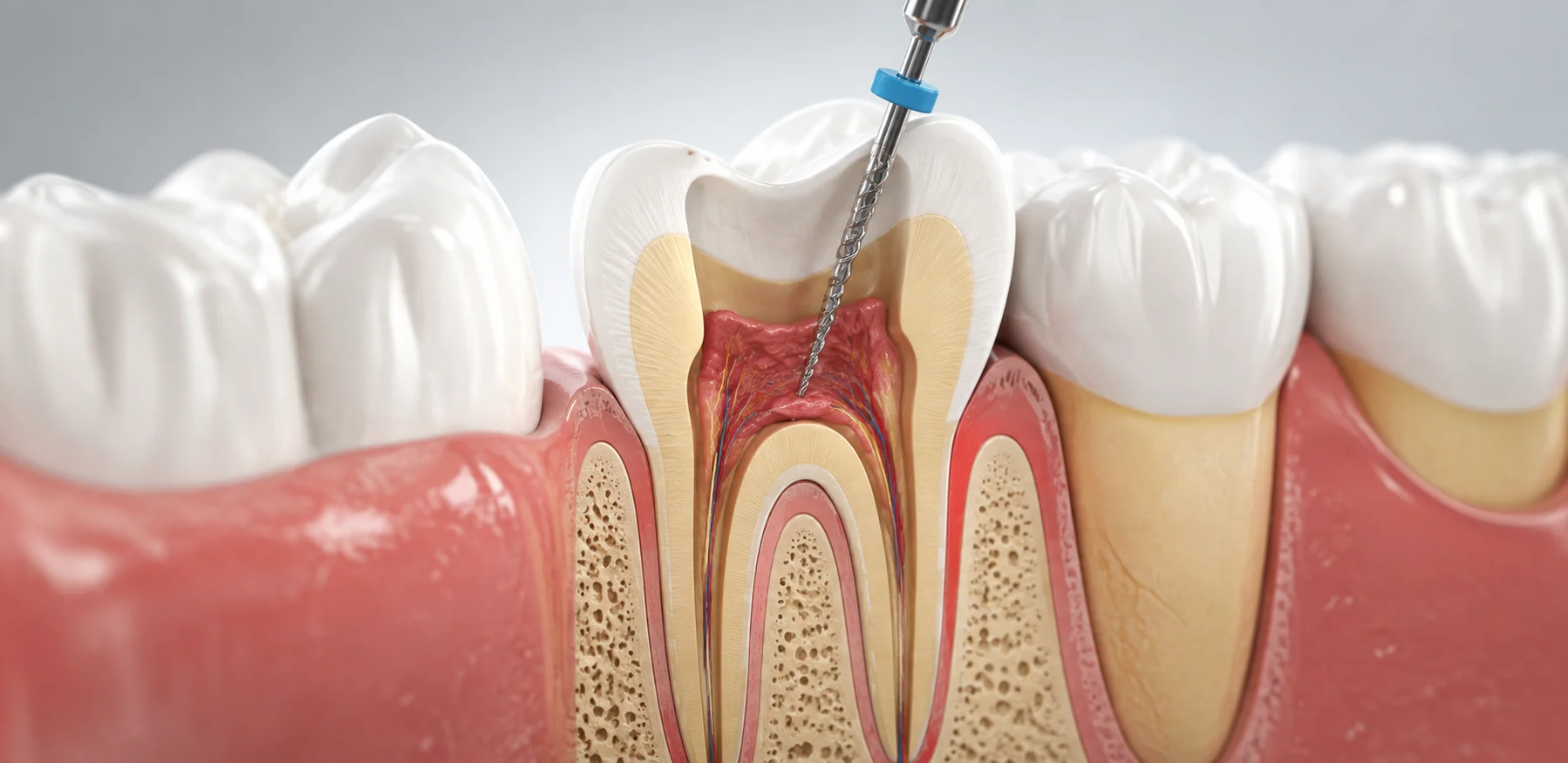 Modern Endodontic Therapy
Modern root canal treatment carefully cleans, shapes, and seals infected pulp canals to preserve natural tooth structure without discomfort.
How Long Does It Take?
This depends on which tooth it is, how many canals it has, how curved or narrow those canals are, and how severe the underlying infection is. Most appointments take somewhere between an hour and two hours. Straightforward cases can be quicker, and complicated multi-rooted cases can take longer.
One Visit or More?
Many teeth can be treated in a single sitting. If your tooth is clinically suitable, single-visit RCT means fewer trips to the clinic, fewer injections, and less time off work. High-torque rotary instruments and apex locators have made single-sitting treatment practical and reliable for many patients in Jaipur.
Other teeth need two or more visits. This happens when the root canals have an intricate anatomy, when persistent infection requires intracanal medication, or when active exudate must be fully cleared before permanent obturation. In those cases, a soothing medicinal dressing is placed and sealed with a temporary filling between visits.
| Tooth / Situation | Usual Number of Visits |
|---|---|
| Simple front tooth (Incisor / Canine) | Often just 1 sitting |
| Premolar tooth | Often 1–2 sittings |
| Molar tooth | Often 1–2 sittings, sometimes more |
| Complex infection or redoing an old root canal (Retreatment) | Several visits may be needed |
These are general clinical guidelines. The permanent crown or final restoration will usually involve a separate impression and cementation appointment.
People sometimes ask us if one sitting is “better.” Honestly, not necessarily. Both approaches work exceptionally well when applied to the right clinical condition. The decision should always depend on the biological state of the tooth, not just convenience. If you are interested in single-sitting treatment, ask us during your consultation and we will examine whether your tooth is a prime candidate.
Does It Hurt?
This is the question everyone asks first. And the honest clinical answer is: during treatment, local anaesthesia keeps the tooth numb. The vast majority of our patients tell us the appointment was far easier and more comfortable than they expected.
If a tooth is severely acute or inflamed (“hot tooth”), numbing can occasionally require extra patience. When that happens, our dental team uses advanced supplemental anaesthetic techniques (such as intraligamentary or intrapulpal numbing) to ensure complete numbness before proceeding.
Afterwards, it is completely normal for the tooth to feel mildly tender or bruised for a few days, particularly when chewing. This mild post-operative discomfort is easily managed with standard anti-inflammatory medicines recommended by your dentist.
Tips for a Smooth Recovery:
- Wait until numbness wears off: Hold off on eating solid meals until sensation returns so you don’t accidentally bite your lip, cheek, or tongue.
- Protect temporary fillings: Avoid chewing hard, sticky, or crunchy foods on the treated side until the permanent restoration is placed.
- Gentle hygiene: Continue regular brushing and flossing, but clean gently around the treated tooth.
- Don’t skip the crown: A root canal treated tooth lacks internal hydration and can become brittle. Completing the permanent crown or filling is vital to prevent tooth fractures.
We understand that dental anxiety is real. For an in-depth breakdown of pain management, anaesthetic techniques, and recovery expectations, you can also read our clinical guide on whether root canals are painful. Remember: putting off treatment usually allows infection to spread deeper into the jawbone, making future treatment more complex. The earlier an issue is addressed, the easier it is to preserve your natural tooth.
How Much Does a Root Canal Cost in Jaipur?
Root canal costs vary depending on the tooth type, the number of canals present, the severity of the infection, and whether a post-and-core or crown is required afterwards. Front teeth usually have a single canal, whereas molars have three or four intricate canals requiring more time and specialized equipment.
| Tooth / Treatment Category | Approximate Cost in Jaipur |
|---|---|
| Front Tooth RCT (Incisor / Canine) | ₹2,000 – ₹4,500 |
| Premolar Tooth RCT | ₹3,500 – ₹6,500 |
| Molar Tooth RCT (Multi-canal) | ₹4,500 – ₹9,000 |
| Root Canal Retreatment (Redoing old RCT) | ₹7,000 – ₹12,000+ |
Please note: These figures are indicative market estimates for Jaipur clinics, not fixed official pricing for Royal Dental Clinic & Hospital. Treatment costs depend on individual clinical findings.
What Pushes the Price Up or Down?
- Canal Anatomy: Molars have multiple, curved canals that require substantially more clinical time and rotary instruments.
- Retreatment Complexity: Redoing an old, failed root canal requires removing previous gutta-percha or separated instruments before cleaning can even begin.
- Advanced Technology: Clinics utilizing digital apex locators, rotary endodontic motors, dental microscopes, and sterile single-use files maintain higher hygiene standards and precision.
- Final Restoration: The root canal procedure and the protective dental crown (e.g., PFM, Zirconia, or E-max) are generally priced separately. Always ask your clinic for an itemized estimate covering X-rays, RCT, and the crown so you know exactly what to expect.
For an accurate clinical estimate tailored to your tooth, we invite you to schedule a consultation with digital diagnostic imaging at our clinic.
Clinical Note: Modern Endodontic Techniques
Clinical insight submitted for review by Dr. Chirag Chamria • Chief Implantologist & Dental SurgeonRotary instruments and electronic apex locators make it easier to prepare canals efficiently and measure their length accurately. For the right cases, they make comfortable single-visit root canal treatment a realistic option. When regular X-rays don’t show enough, 3D CBCT imaging can be helpful in selected complex cases.
Research shows that teeth treated with root canals are kept at high rates. Still, every tooth is different. The outcome depends on the original infection, the tooth’s anatomy, the quality of the treatment, the final restoration and how well the tooth is cared for over the years. No dentist can honestly promise a particular success rate for every tooth or every patient.
Frequently Asked Questions About Root Canal Treatment
It’s a narrow channel inside the root of a tooth that holds pulp tissue. Root canal treatment cleans and seals these channels when the pulp is infected or too inflamed to recover.
Root Canal Treatment. It removes damaged pulp from inside the tooth and seals the canals so you can keep the tooth.
The tooth is numbed, a small opening is made, the damaged pulp is removed, and the canals are cleaned, disinfected and filled. The tooth is then restored with a filling or crown.
Usually around one to two hours per appointment. Some teeth are finished in one visit, while others need more.
Most people manage very well with local anaesthesia. Some soreness afterwards is normal and settles as the area heals.
Yes, if the tooth is suitable. Your dentist will tell you whether one visit or several makes more sense.
With good treatment, a proper restoration, regular check-ups and good brushing and flossing, many root canal-treated teeth last for years.
If the tooth can be restored, a root canal often lets you keep it. If it’s badly broken or can’t be reliably restored, extraction may be the better choice.

Dr. Chirag Chamria (MDS)
Dr. Chirag Chamria holds a Master of Dental Surgery (MDS) in Oral & Maxillofacial Surgery & Implantology. With over a decade of surgical expertise, he specializes in Zygomatic Dental Implants, Immediate Full Mouth Rehabilitation, and Maxillofacial Oral Cancer Reconstruction at Royal Dental Clinic & Hospital, Shastri Nagar, Jaipur.
Have Questions About Root Canal Treatment?
Schedule a painless digital examination and 3D diagnostic evaluation with Dr. Chirag Chamria and the endodontic team at Royal Dental Clinic & Hospital, Shastri Nagar, Jaipur.
Royal Dental Clinic & Hospital Jaipur
Center for Advanced Endodontics, Dental Implants & Smile Architecture
Plot No. 7, Subhash Nagar Road, Infront of Krishna Kripa Apartment, Shastri Nagar, Jaipur, Rajasthan 302016, India
+91 96944 46633
Dr. Chirag Chamria (Chief Implantologist & Dental Surgeon)